LIVE 24/7
New York
--:--Generative house, all day and night
--sun elevation
--azimuth
--next sunrise
24/7 generative house radio · New York & Los Angeles
Two live radio stations on YouTube, one for each city. The real sun over New York and Los Angeles picks the style and the tempo, the live weather changes the picture, and every sound is synthesized the moment you hear it. No samples, no loops, no playlist. Nothing plays twice.
Live now
This page works out the sun over each city from your clock, the same way the stations do, and shows which part of the day is on air.
Tempos blend smoothly between phases, and some phases rotate between styles, so the stream itself always has the last word. The weather on screen is live from Open-Meteo.
How it works
HELIODON is a program that composes, plays and films house music in real time, around the clock. It runs on one small server and streams straight to YouTube.
Every second the station computes where the sun is over its city: elevation and direction, from the NOAA solar equations and the city's latitude and longitude. No feed, no lookup table.
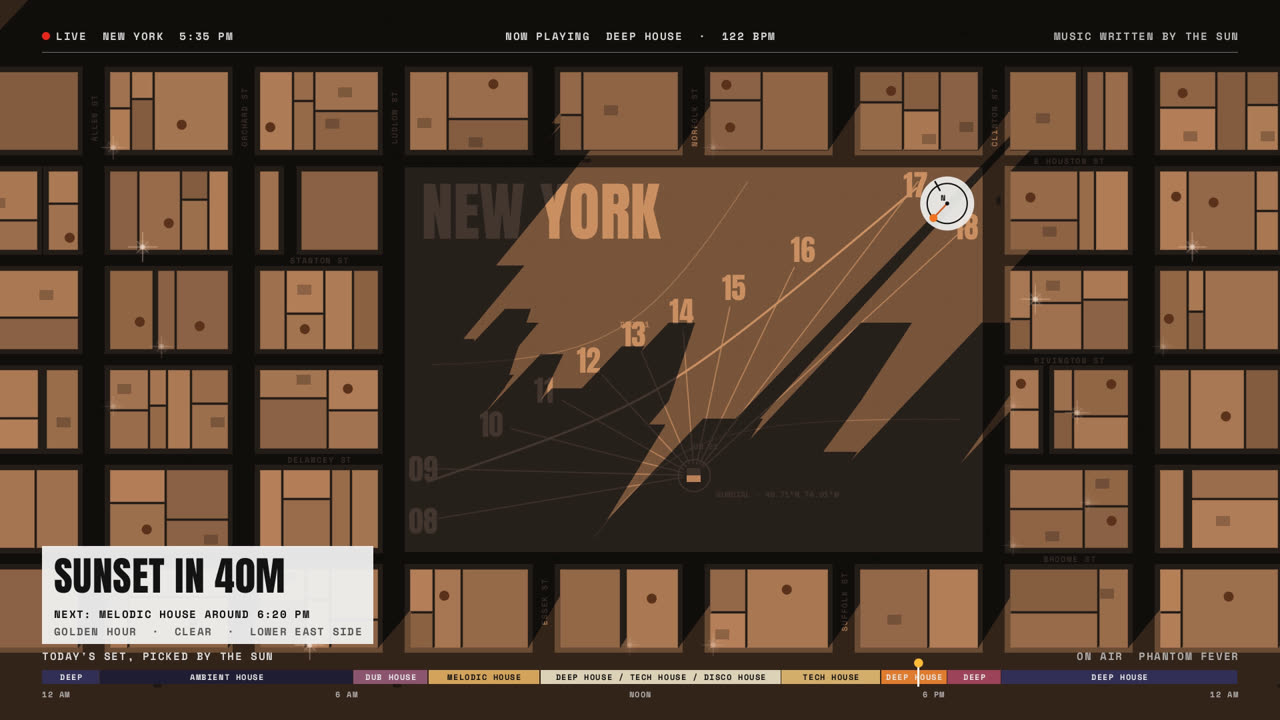
The sun's height and whether it is rising or setting place the moment on an eight-phase day, from deep night through dawn, midday and golden hour to night. Each phase has its own style, tempo, key and colour.
Synthesizers written from scratch play drums, bass, pads and chords that a sequencer composes bar by bar: intro, groove, build, drop, break. A new style only arrives at the end of a phrase, so changes feel like a DJ's mix, never a cut.
Live conditions over the city change the picture: clouds and their shadows, rain, snow, fog, storms. On a grey day the top end gets brighter and busier, to make up for the missing sun. At night it leaves the music alone.
Each frame is drawn from the same sun and the same sound: real shadows, a clock that is a sundial, light that pulses with the kick. The music and the image are one program, rendered 30 times a second.
Weeknight small hours are beatless: pads and slow bells. In New York, Friday and Saturday nights turn to techno until dawn. The morning waits for the sun, but never starts before the city's clock says so.
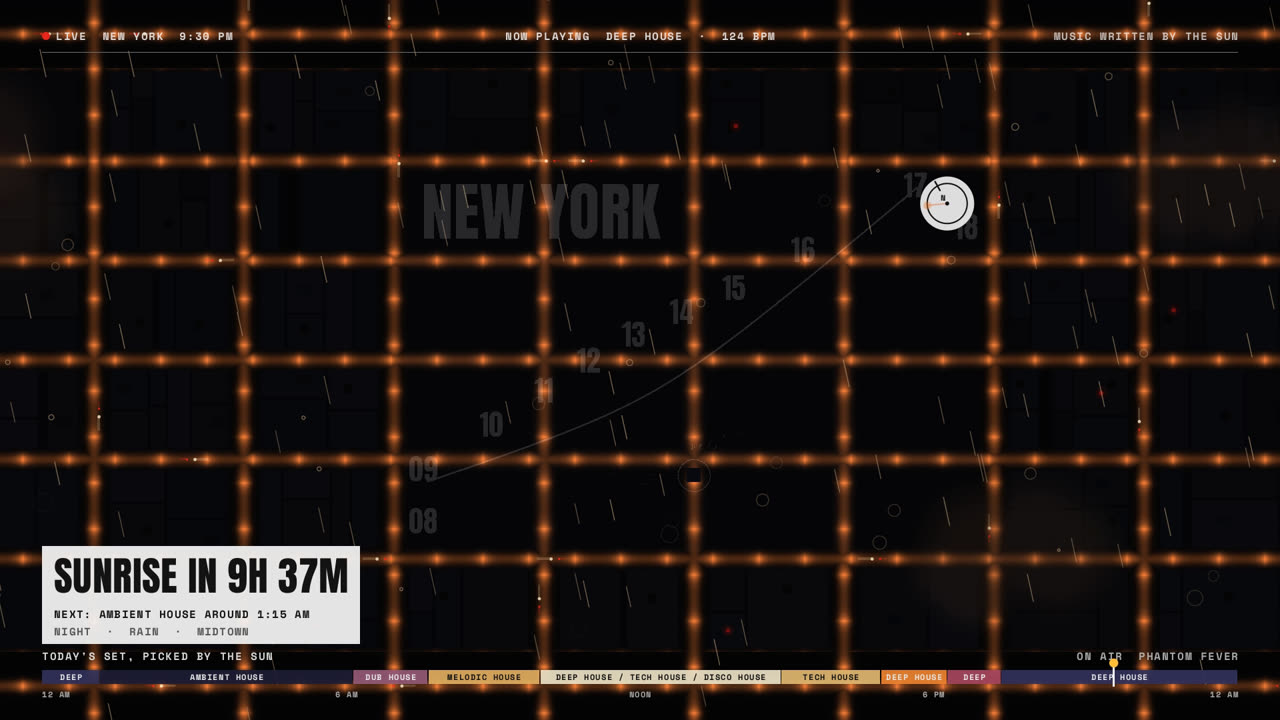
A top-down view of a Manhattan street grid around a sundial plaza. Every tower casts the real shadow of the sun over New York right now, and their heights move with the music. At night the street lights, traffic and roof beacons take over.
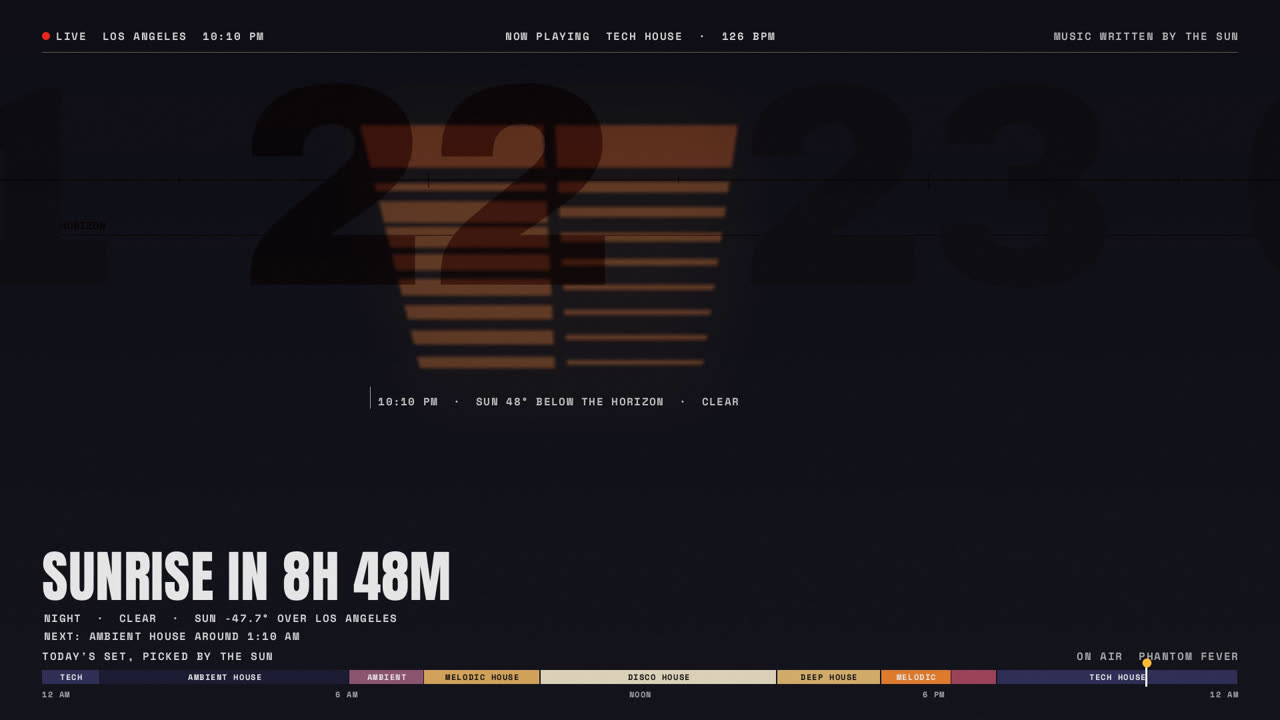
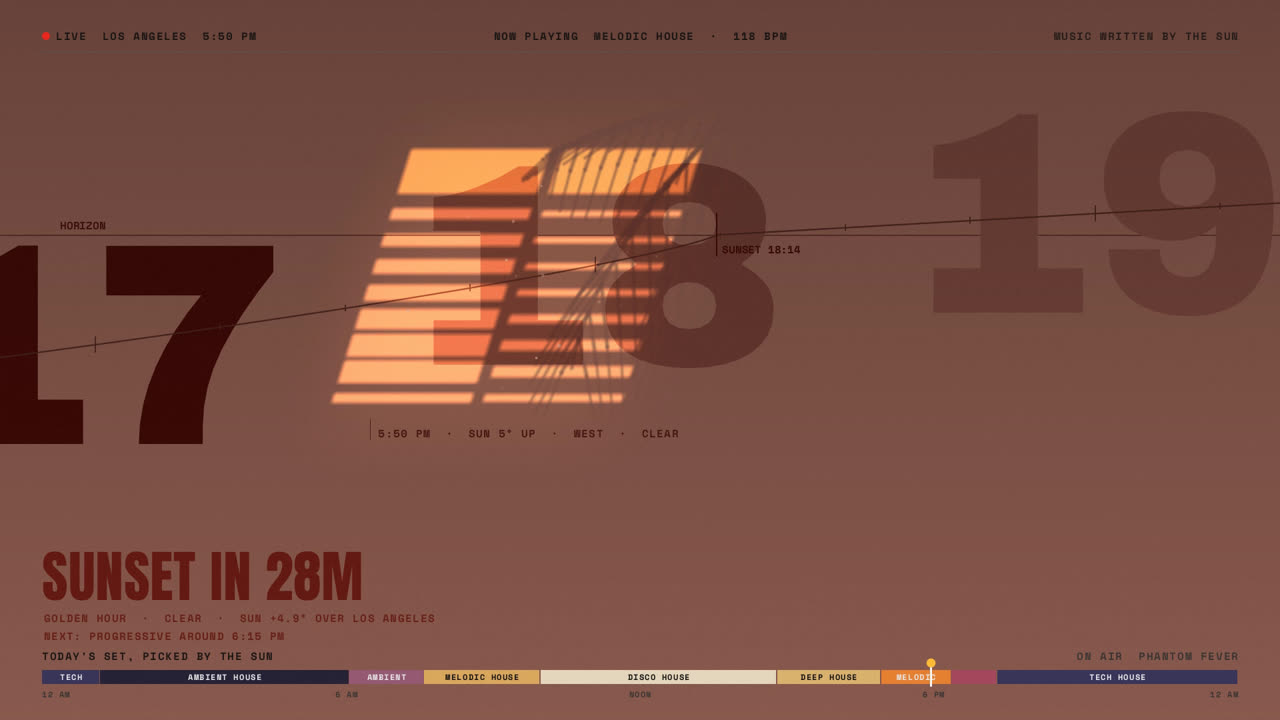
The back wall of a room on Pacific time. Sunlight comes through a slatted window and travels across giant hour numerals along today's path of the sun. The slats open with the music and breathe with the kick; at night, sodium light from the street and passing headlights.
A day on air
The same strip runs along the bottom of each stream. The phases move every day with sunrise and sunset; times below are today's, in each city's local time.
Replays, not reruns
The long mixes and Shorts on the channel are cut from moments that actually went out live. The station keeps a log of each broadcast, and a replay renders that window again note for note, checking every minute of audio against what aired. If anything drifts, the replay stops.
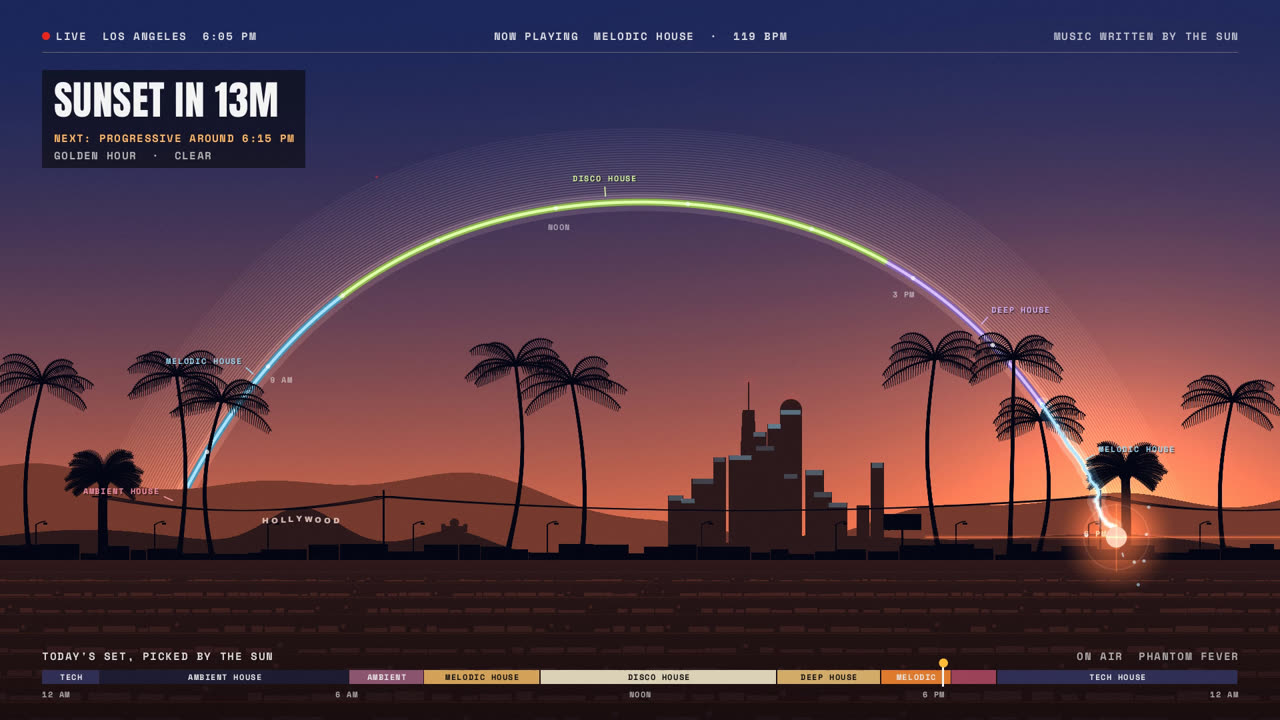
So a "Sunset in Los Angeles" mix is the sunset that played that evening, at the tempo the sun chose.
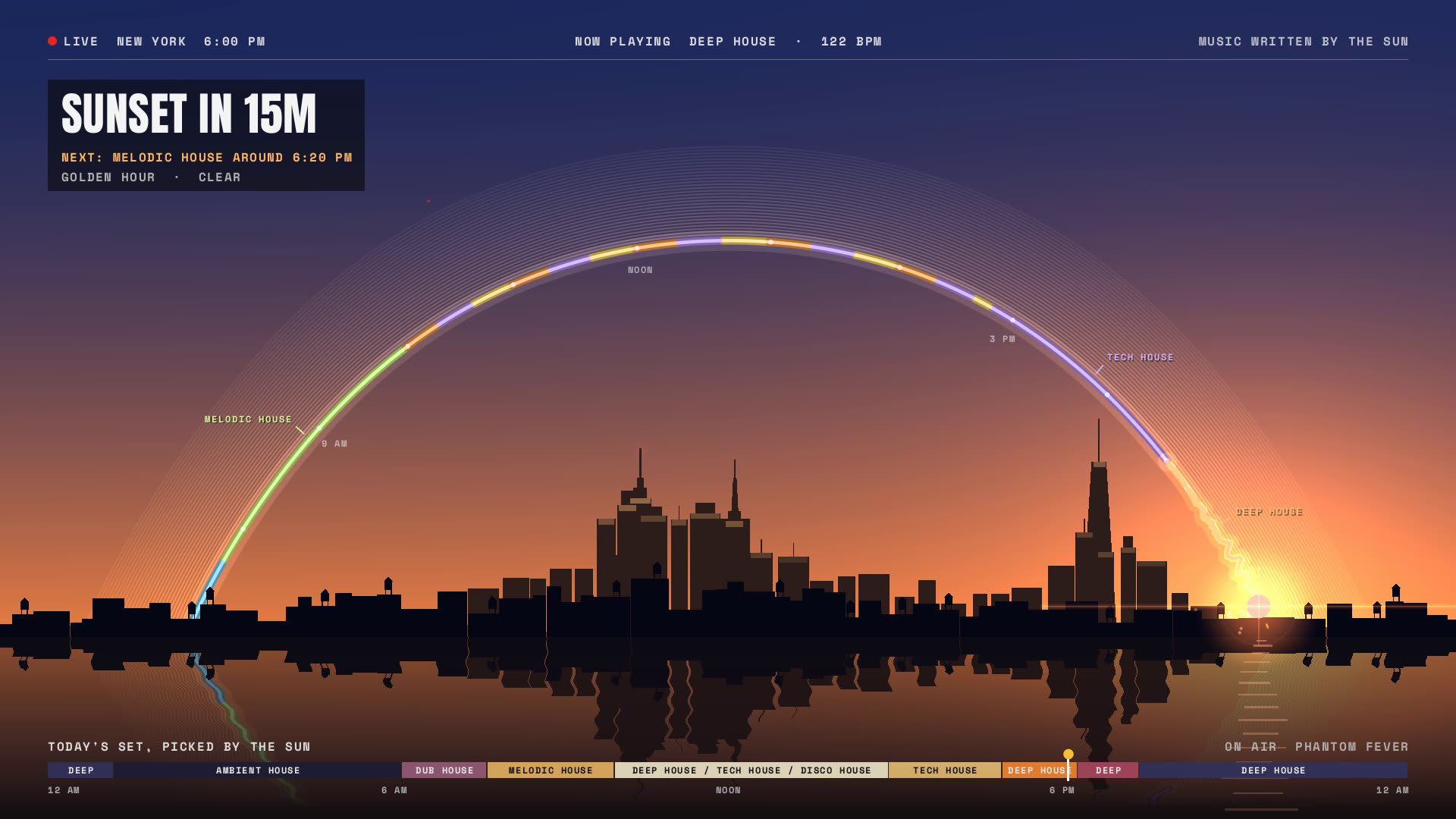
Shorts and long mixes are drawn as a solargraph: like a pinhole camera left out all day, the sun burns its arc into the sky, and every stretch of the trail takes the colour of the style that was playing.
Questions
No machine-learning model is involved. HELIODON is generative in the older sense: hand-written synthesizers and composition rules, played by a program. No samples, no loops, no recordings.
No. Patterns, harmony and arrangement are generated as it plays, and the sun and the weather never line up the same way twice.
Because the sun is the conductor. As it drops toward the horizon the station moves into golden hour, then dusk, and the style changes at the end of the next musical phrase.
Two coasts, three hours apart: when New York reaches golden hour, Los Angeles is still in its afternoon. Each station runs on its own city's sun, time zone and weather.
From Open-Meteo.com, checked every few minutes for each city.
Write to hello@heliodonradio.com.
For Google and YouTube
HELIODON uses a small private application, run only by the channel's owner, to publish the channel's own replays to the HELIODON YouTube channel through YouTube API Services. It:
It is not offered to anyone else, does not sign in other users and does not touch any other channel. What it accesses and how the data is kept is in the privacy policy; see also the terms.